Showing posts with label Mystery. Show all posts

Tuesday, October 4, 2016

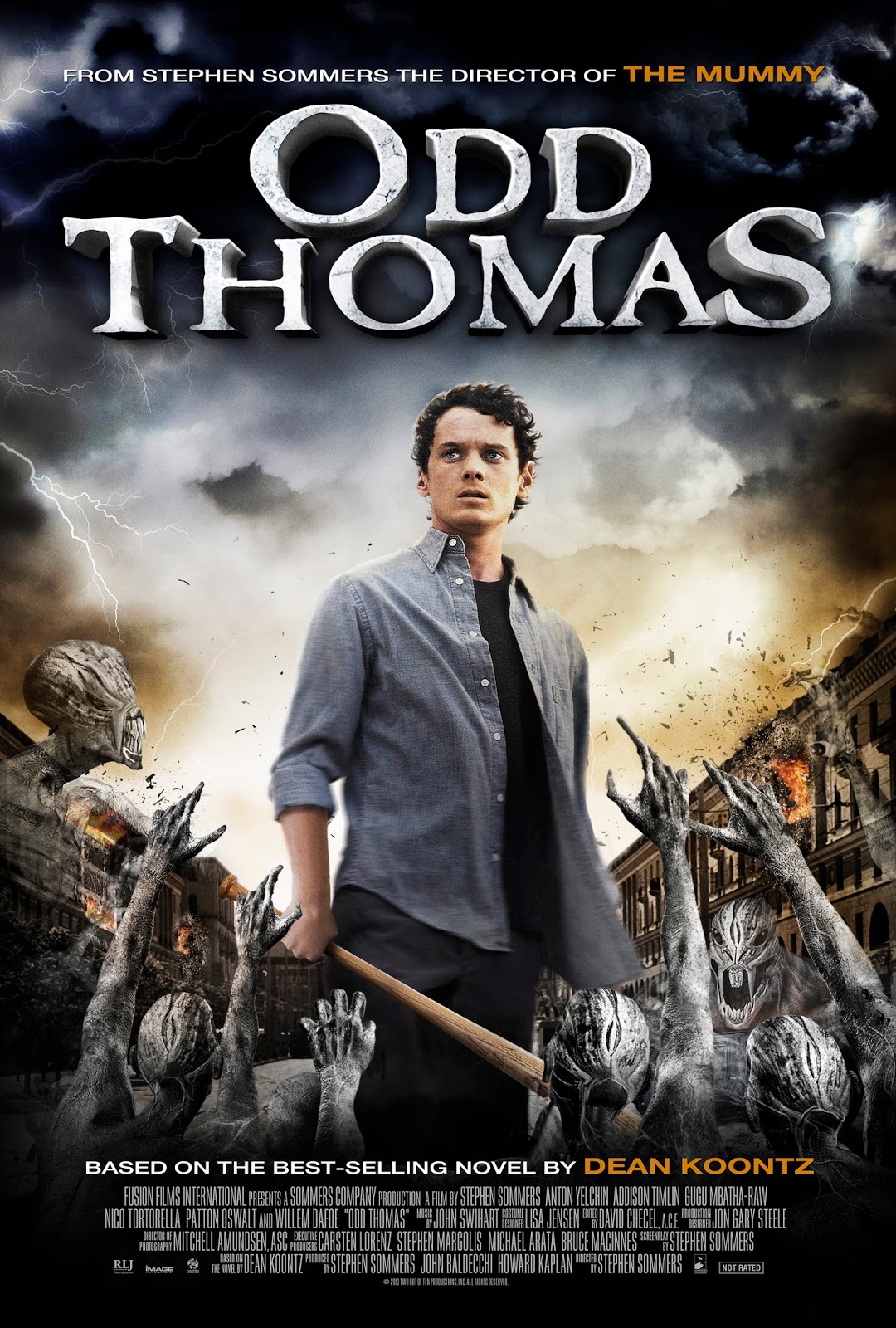
04 of 31 Horror Films I've Never Seen 2016: Odd Thomas (2013)

Critical writing can be a god damn pain in the ass.  The writer wants to be fair, but must also admit his/her biases, and get through all the muck to some how quantify a qualitative written review.  Some writers revel in writing negative criticism and while I've found myself in the position to do so, I don't enjoy it, but here I am about to write a mostly negative review of Stephen Sommers' Odd Thomas.


The first of a series of popular novels by Dean Koontz and set in a fictional California desert town called Pico Mundo, Odd Thomas is a film about a young man who is a detective for the dead.  He has a psychic gift to spirits of murdered people and helps capture their murderers.  His power then leads him to a chance to prevent a mass murder in his town, but not without cost.  At the start the film is a supernatural detective story with a lot of quirky dialogue and comedy thrown in for good measure.  Anton Yelchin, who played the lead, truly is the star of the show, relegating pretty much everyone else (Willem Dafoe, Addison Timlin, et al) to the background.  He embodies the idea of the character superbly, but unfortunately that does not save the film.


The thing about genre bending is that there has to be some sort of underlying thematic or tonal consistency.  Odd Thomas is all over the map.  The opening, which I enjoyed, sets up the story and the protagonists quite smoothly and although there is the strange discrepancy of a small town police chief (Willem Dafoe) being supportive of this strange kid's endeavors, it's one that is easy enough to overlook.  The character dynamic of star crossed love between Odd and Stormy (Addison Timlin) comes across well, but at times in a sort of annoyingly predictable way.  When you know how a scene is going to play out before it's finished playing out it's because you're characters have become 2-dimensional, which, again unfortunately, seems to happen a number of times throughout the middle portion of the film.


Stylistically, the look of the film was probably the most consistent part.  The desert environment is amplified by warm cinematography which is an added bonus.  Most horror films seem to adopt a very de-saturated cold look, which at this point has become a tiresome cliche.  This doesn't fully save the film, but it is a saving grace.  The ending "twist" was kinda wasted with bad pacing and a sudden drastic tonal shift that, while effective in eliciting emotion, still left me thinking "Really?  That's it?"  To summarize: Odd Thomas is not a bad film, but it's not a good film either.  It all comes down to personal taste and while it does offer quite a bit, it fails to offer enough.  Make your own decision and rent it or watch it on Netflix.


Saturday, August 15, 2015

Masks (2011): Number 2 in a Series of Reviews of Neo-Giallo Films

Where does one draw the line between inspiration and theft?  Better yet, where does one perceive said line?  If you're a film goer you have probably heard every opinion in the world about Quentin Tarantino, between people calling him a thieving hack, or a tributary genius.  Personally, I find it peculiar that so much attention is focused on anyone's originality, or lack thereof, in an industry that is chiefly focused on getting money out of your pocket by way of entertaining you.  I'll grant the fact that some films are such obvious ripoffs that they may as well be "theme porn," but I can't really fault anyone for taking their inspiration and pushing it as far as they can go.  Masks, a German Neo-Giallo, has been described as a Suspiria ripoff by commentators on the imdb boards, but I think that's far too simple of a dismissal of a film who's third act literally punches the viewer right in the gut.


While the focus of this is not about comparison, there are a few that need to be addressed so we can get down to business.  Like Suspiria, Masks is about a female protagonist who enrolls at a strange Academy in the countryside.  Transpose Dance to Drama and voila!  Aside from a similar use to theatrical lighting in certain segments, this is the only real similarity to Dario Argento's supernatural horror story.  The lead of the story, Stella (debut performance by Susan Ermich), goes to the Matteusz Gdula School after rejection from almost every other acting Academy in town.  Though clunky at first, the teacher's see a spark in here and accept her to the school.  Unfortunately, the school, and Gdula's method, have a dark and unsettling past.  Eager to become a great actress, Stella is drawn into the darkness like a moth to the flame, with some rather unsettling consequences.


This film, is a Giallo through and through.  The acting, while not bad, isn't the greatest thing on Earth, but the characters and story are interesting enough to enjoy the more banal parts of the exposition until it gets to the delightfully fucked up meat that make up the second half of the film.  The title of the film only has one literal reference (though there is a masked killer in the story) and is linked metaphorically to Stella.  Everyone is wearing a mask shaped by their experiences and to truly break free of themselves and become their characters they need to strip this mask off.  The idea of being artistically reborn is even literally placed into the context of Gdula's acting method, which involves a cornucopia of strange and unsettling drills, including hallucinogenic drug use, hypnotic suggestion, physical abuse, and other torments to bring the pure emotions of fear and rage out of the actors.


Writer, Director, Editor Andreas Marschall knows his stuff, in this case, and employs many satisfying methods to fit Masks into the Giallo canon.  The thudding bass and piercing guitar driven score by Sebastian Levermann recalls Bruno Nicolai's intro theme to Sergio Martino's The Case Of The Scorpion's Tail.  The creeping camera and beautiful lighting of Sven Jakob also add to the atmosphere of impending dread.  The sound design could probably have used a bit more of a punch, but the other elements made up for it's lack, though I noticed a couple of familiar canned screams that almost made me burst out with laughter at their inappropriate placement.


At 112 minutes runtime, Masks is definitely more of a slow burn that, even when it gives itself away, packs a few surprises and a rather ambiguous, albeit, bloody finale that is worth the wait.

Monday, March 5, 2012

"If There Is No Love, Make Him Pay For It"

I love Japanese Cinema. If it weren't for Japanese Cinema, I doubt I would've gotten interested in working in the film industry. That said, my favorite of the contemporary Japanese Directors is, without a doubt, Sion Sono. Most people know him, if they're aware of him at all, for The Suicide Club a bizarre trip into psychological horror.  Over the past couple of years he's been making his films at break neck speed, producing a minimum of 2 films a year, which makes this review almost dated.  Luckily, the film I'm going to talk about is relatively hard to find in America, so in that way this review will hopefully be relevant.


Based on true events, Guilty of Romance is the third and final part of Sono's "Hatred Trilogy" which began with his 237 minute epic, Love Exposure.  The film opens with a blurb about Love Hotels in Shibuya (a district in Tokyo) and prostitutes who frequent them.  It then launches into a mystery about a murder in which a parts of a body were found fused with the plastic arms, legs, and head of a mannequin.  Sono tells us his story via past and present tense revealing the past tense details in time with their discovery by the present tense detectives.  What unfolds is a sort of negative hero's journey in which the lead character Izumi Kikuchi (fantastically performed by Megumi Kagurazaka), a bored housewife living in a very chaste relationship with her husband is drawn into a seedy world of depravity.  Ironically, it is this depraved world that allows her to express herself fully, putting somewhat of a skip in her step.  Until...


Everything starts spiraling out of control.  Izumi is mentored by another woman Mitsuko Ozawa (Makoto Togashi.) Literature Lecturer by day, prostitute by night, Mitsuko teaches Izumi methods to take control and further gain confidence in herself.  Mitsuko is an enigmatic force with questionable motives that will keep the viewer guessing up until the end of the film.

Sono has become a master of finding poetry in the dumpster.  Here we have a story about the rejection of decency and the headlong dive into the obscene and yet there is a sense of tragic beauty in his characters.  Are they completely to blame for their present condition or are the norms of society so strangely defined that they are pushed in one direction or another?  Sono doesn't entirely answer this question.  While at moments it feels like he is taking one side or another, it's almost always a red herring.  He leaves it up to the audience to decide, rather than try to instill some sort of ideology.


The one moment where it seems like Sono is making a statement is at a bizarre dining table scene.  The scene speaks loads about societal class division and he advertantly critiques the way of underhanded politeness in Japanese society.  While his seem is very on the head, full of frank dialogue, the characters are all smiles and laughs.  In many of Yasujiro Ozu's films, such scenes do NOT contain the frank stabbing dialogue.  Instead, while a character may be chastising or criticizing another, they use polite language in a most passive aggressive manner.


Upon completing the film, I discovered that the cut I watched is also 30 minutes shorter than the Japanese release.  This, of course, has me curious and I will definitely seek out the longer cut to compare the differences.  That is not to say, that I didn't enjoy the international cut, but I am a stickler for watching the absolute closest thing to a true "Directors Cut."  Regardless, Guilty of Romance, may very well be considered a poem of depravity.  As beautiful as it is disgusting, Sono has once more tapped into the not so hidden dark side of an overtly polite and clean society.

Friday, January 27, 2012

What I Mean When I Say "GIALLO!"

For the last few days I've been avoiding watching new films, probably in a subconscious effort to sabotage this blog, which seems ludicrous and is just like me.  To circumvent my own stupidity I submit to you this film from 1973 by Italian director Antonio Margheriti (here credited as Anthony M. Dawson), the name used by Eli Roth's character in the final scenes of Inglourious Basterds.  If you know anything about this period of Italian Cinema, you know it was dominated by a genre of pulpy, murder/mystery, exploitation films called Giallo.  The name comes from the little pulp paperbacks that many of the films are based on which were printed rather cheaply with yellow covers.  Giallo is also the Italian world for Yellow, as it were, so the name just stuck.  Enough history, let's get into Six Deaths In The Cat's Eye.


The story is set in a small Scottish village and follows a series of murders taking place near a castle and the MacGrieff family who dwell in it.  According to legend (in context of the story) when a MacGrieff kills one of his kin the deceased will become a vampire.  All of the murders seem to be witnessed by the family cat which lurks around the film letting the audience question whether or not it is somewhat of an ethereal being itself.


Corringa (played by Jane Birken, mother of Charlotte Gainsbourg), the niece of Lady Mary MacGrieff, is the principal lead of the story.  She arrives at Castle Dragonston where her Aunt and Mother are arguing about the future of the castle.  A dinner scene introduces the rest of the characters, a Priest, a seductive French Teacher, a secretive Doctor, and Lord James MacGrieff (played by Hiram Keller), the supposedly 'Mad' son of Mary.  Motive is set almost immediately for murder but as is a staple of good Giallos, we are constantly made to guess until the climax of the film.  That being said, the film is in no way a typical Giallo, instead having a very Gothic horror feel to it similar to the Hammer Studios pictures of the same era.


One of the things I really like about the film is the atmosphere.  The film makes great use of shadow and motivated light sources.  One light source in particular is an oil lamp with a multicolored hood that throws out an array of red, green, yellow, and blue at a few crucially creepy moments thereby emphasizing the terror (and sometimes eroticism) portrayed by the actors.

Many Giallo's are well known for the exploitative look at sex and violence.  As the years progressed and the technology progressed many of them got gorier and some practically devolved into hardcore pornography.  That is not the case of this film.  While the blood does certainly flow, it is not without a macabre sense of taste.  The weapon of choice in the film is a straight razor to the jugular and unlike a Fulci film the emphasis is not on the tearing open of the neck, but of the blood flying from the wound.  Whether this was due to makeup or time constraints is debatable, but it was quite effective regardless.


While many Giallo's suffer from censorship and long term neglect, this film has been preserved quite well and can be found on DVD in both English and Italian languages.  The English dubbing is particularly interesting because many of the side characters, who were dubbed over, have thick Scottish accents including slang.  One such appearance is of Birken's partner, the late the Serge Gainsbourg, as a Scotland Yard inspector.